Audio & wearables
Open-Ear and Bone Conduction Headphones Explained
Open-ear headphones play sound near your ear instead of sealing it, so you can still hear traffic and people around you. True bone conduction models send vibrations through your cheekbones; many clip-on designs use tiny speakers aimed at the ear canal instead. Both trade some bass and privacy for awareness and comfort.
Most earbuds seal your ear canal to block outside noise. Open-ear headphones do the opposite: they leave your ears open so you hear the world around you. That makes them popular with runners, cyclists and anyone who finds in-ear tips uncomfortable.
Two kinds of open-ear headphones
| Type | How it works | Sound |
|---|---|---|
| Bone conduction | Pads resting on the cheekbones send vibrations through bone to the inner ear | Clear voices, light bass, a slight tickle at high volume |
| Air conduction open-ear (clip or hook) | A small speaker sits just outside the ear canal | Fuller sound than bone conduction, still lighter bass than sealed earbuds |
Listings often use "bone conduction" loosely. For you, the important part is the open-ear fit: nothing goes inside your ear.
Who open-ear headphones suit
- Runners, cyclists and walkers who need to hear traffic.
- People who find in-ear tips uncomfortable or get ear infections easily.
- Parents and office workers who want music or calls while staying aware.
- Glasses wearers, as long as the clip or band does not press on the frames.
The trade-offs
- Less bass and less isolation: in a loud place you will want more volume.
- Sound leakage: others nearby may hear your music.
- Calls: fine in quiet places; outdoors, wind affects the microphone.
 Ear-Clip Open-Ear EarbudsBluetooth 5.3, a 300 mAh case with about four recharges.Watch the reel →
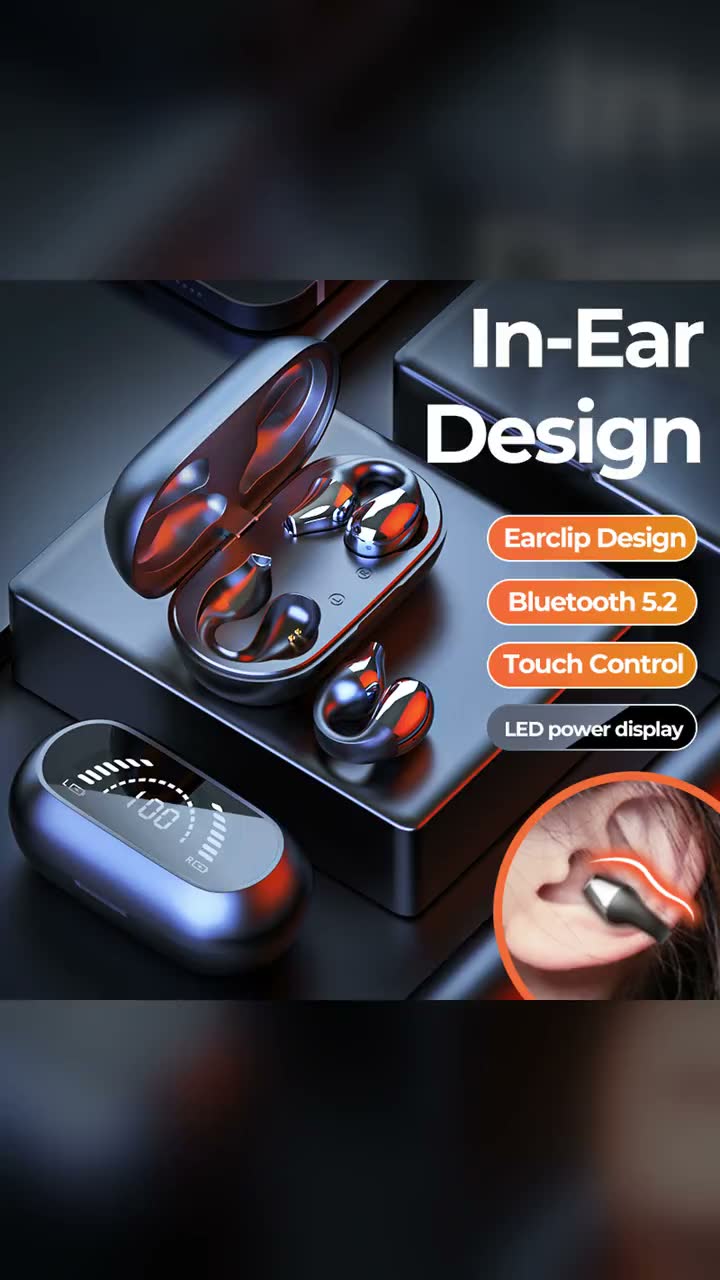 Ear-Clip Headphones (BT 5.2)A clip-on pair that sits on the outer ear.Watch the reel →
Listening safely
Open-ear does not mean hearing-safe. The World Health Organization's safe listening guidance for adults is up to about 80 dB for 40 hours a week; louder needs less time. Practical rules:
- Keep volume at a level where you can still hold a conversation.
- Take breaks during long sessions.
- Turn the volume down rather than up when traffic gets loud.
Open-ear or sealed earbuds?
Choose open-ear for outdoor exercise and all-day awareness. Choose sealed in-ear earbuds for noisy commutes, flights and deep bass. Many people own both. Compare sealed options in our wireless earbuds under $30 guide.
Frequently asked questions
Are bone conduction headphones safe for your hearing?
They still deliver sound to your inner ear, so loud volume can still damage hearing. Their advantage is awareness, not hearing protection; keep the volume moderate.
Can other people hear my open-ear headphones?
At higher volumes, yes. Open-ear designs leak some sound, so in a quiet office or library people nearby may hear your music.
Are open-ear headphones good for running?
Yes, that is one of their main uses. You can hear cars, bikes and people around you, and nothing sits inside the ear to get sweaty or fall out.
Do open-ear headphones work on a noisy train?
Not well. Because they do not block outside sound, you would need high volume to hear over a train or plane. Sealed in-ear earbuds suit noisy commutes better.